- Home
- News
- Institute news
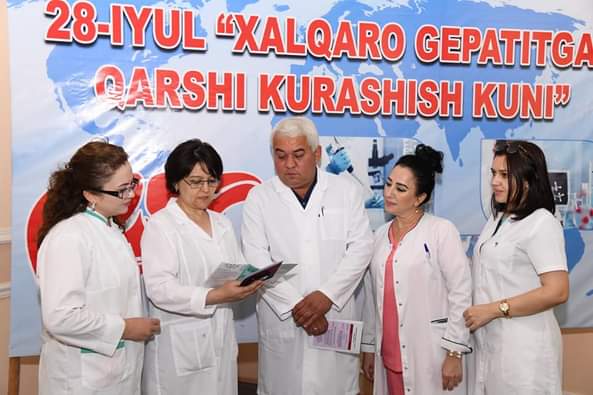
- Every year, July 28 is widely celebrated around the world as International Hepatitis Day.
Every year, July 28 is widely celebrated around the world as International Hepatitis Day.
Every year, July 28 is widely celebrated around the world as International Hepatitis Day. The main goal is to further raise awareness of the world's population about hepatitis and raise awareness of this disease.
In this regard, the Republican Specialized Scientific and Practical Medical Center for Epidemiology, Microbiology, Infectious and Parasitic Diseases, together with the Ministry of Health of the Republic of Uzbekistan, the Sanitary and Epidemiological Welfare and Public Health Service of the Republic of Uzbekistan, the Research Institute of Virology, the Republican Specialized Center for Epidemiology, Microbiology and Epidemiology, the Scientific and Practical Medical Center for Infectious and Parasitic Diseases and the Association of Hepatologists of Uzbekistan organized an event in pursuance of the Decree of the President of the Republic of Uzbekistan dated May 16, 2022 No. PP-243 "on improving measures to combat the spread of some current viral infections".
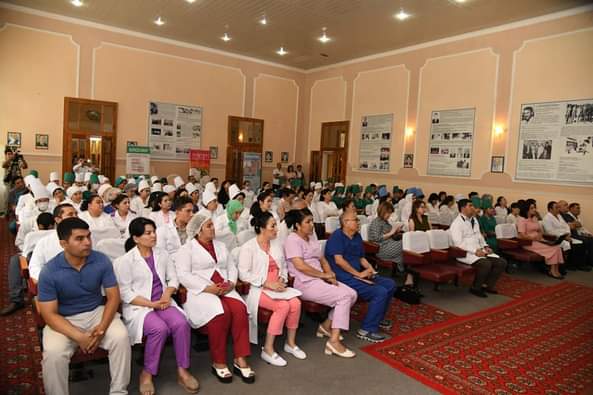
It was attended by employees of the Ministry of Health, the Sanitary and Epidemiological Welfare and Public Health Service, the infectious diseases hospital, doctors of the scientific center, hepatologists and media workers.
According to WHO, every year about 325 million people in the world become infected with the hepatitis B virus, and at least 200 million with the hepatitis C virus. As of 2020, 500-700 thousand people die annually from hepatitis B infection, and more than 350 thousand patients die from complications of hepatitis C. According to the World Hepatitis Alliance for July 2021, 1.4 million people die annually due to the hepatitis B and C viruses. This is more than HIV / AIDS and malaria.
In the decree of the President of our country "on improving measures to combat the spread of certain current viral infections" dated May 16, 2022, the main areas for further improvement and expansion of medical and social assistance provided to the population for timely prevention and diagnosis, treatment of certain viral infections among the population are defined as:
— conducting screening studies in all regions of the republic for the early detection of viral hepatitis B and C and increasing the coverage of treatment for the disease;
— full coverage of vaccination against hepatitis B infection for individuals at increased risk of infection, including healthcare workers working with blood and its components;
- free provision of medicines during treatment of patients who have been diagnosed with viral hepatitis C during screening examinations;
- phased full provision of consumables (reagents and test kits) for detecting viral infections in the primary health care system;
- creation and maintenance of a single electronic registry of chronic viral liver diseases in all medical and preventive institutions, the sanitary and epidemiological service and non-governmental medical organizations;
- improving control over the safety, quality and effectiveness of vaccines, test kits and antiviral drugs;
- conducting scientific research on the problems of viral infections, introducing an automated control system diseases;
— conducting large-scale explanatory, propaganda and propaganda work among the population on measures to prevent the transmission of viral infections.
In our republic, together with the Ministry of Health of the Republic of Uzbekistan, the Service of Sanitary and Epidemiological Welfare and Public Health of the Republic of Uzbekistan, free screening processes continue in the following family clinics:
Tashkent city:
- Central polyclinic of Shaykhantakhur district;
- Central clinic of Chilanzar district;
- Central polyclinic of the Uchepinsky district;
- Central clinic of Almazar district;
- Family clinic No. 8 of Mirzo-Ulugbek district;
- Family clinic No. 30, Yashnabad district.
Andijan region:
- Family clinics No. 1, 2, 3 and 4 cities Andijan.
Bukhara region:
- Family clinics No. 4, 5 and 11 of the city of Bukhara;
— Central Multidisciplinary Polyclinic of Gijduvan District.
Jizzakh Region:
- Jizzakh City 1-, 2-, 3-, 4 and Family Polyclinics No. 5.
Kashkadarya Region:
- Multidisciplinary Central Polyclinic of Karshi City;
- Karshi City Family Polyclinic No. 4, 5 and 6;
— Multidisciplinary central polyclinic of Chirakchi district.
Navoi region:
- Family polyclinics No. 1, 2, 3 and 4 of the city of Navoi.
Namangan region:
- Family polyclinics No. 1, 3, 9 and 10 of the city of Namangan.
Samarkand region:
- Family polyclinics No. 2, 4, 9 and 12 of the city of Samarkand.
Surkhandarya region:
- City of Termez 1-, 2-, 3-, 4 and family Clinic No. 5
Syr Darya region:
- Central multidisciplinary clinic of the Syrdarya region;
- Multidisciplinary central clinic of Mirzabad district;
— Multidisciplinary central clinic of Yangier city;
- Family clinics No. 2 and 4 of the city of Gulistan;
Tashkent region:
-Multidisciplinary central clinic of the Upper Chirchik region, family clinics No. 66 and 67.
— Family doctor's office in Saxony.
Fergana region:
- Family clinics No. 1, 4, 5 and 6 of the city of Fergana.
Khorezm region:
Multi-disciplinary central clinic of the city of Urgench and the Republic of Karakalpakstan:
Family clinics No. 1, 2 and 3.
- Family clinics No. 1, 3, 5 and 6 of the city of Nukus.
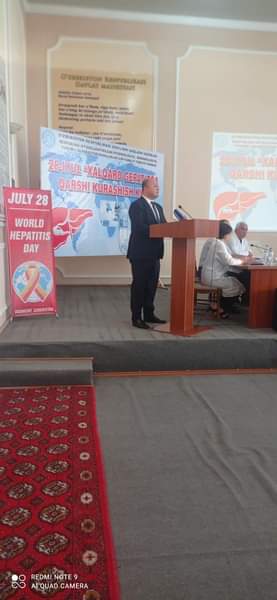
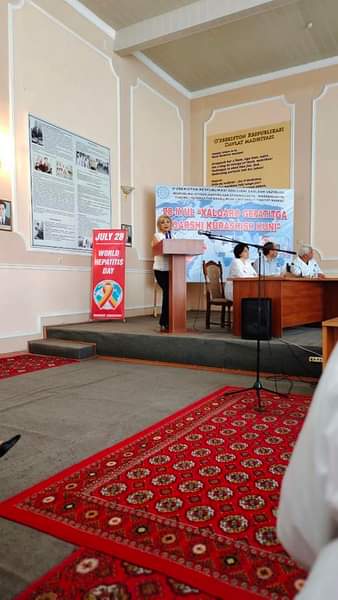
During the event, industry experts spoke, spoke in detail about the harm of hepatitis, measures for its prevention. The participants were also provided with information about the work being carried out in our country today to eradicate and detect this disease early.
The event was attended by 134 medical workers, 80 of them offline and 54 online. Among the foreign representatives, Jin Hee Kim, a graduate student at the Yale School, participated.
In conclusion, the media representatives received comprehensive answers to all their questions.